Research has been integral to the Bonny Method since its origins in the consciousness studies of the 1970s. Over the past four decades, clinicians and academics across multiple countries have contributed to a growing body of evidence on GIM’s clinical effectiveness.
800+
Dr. Denise Grocke at the University of Melbourne has compiled over 800 research studies in GIM.
The work spans qualitative, quantitative, adaptation, and music analysis studies.

Key findings
01 · MOOD AND STRESS
Sustained reduction in stress markers
GIM reduced mood disturbance, depression, and fatigue. Cortisol levels continued to decrease even 7 weeks after the last session.
McKinney et al., 1995 / 1997
02 · PSYCHIATRIC SYMPTOMS
Decrease in psychiatric symptoms
Participants showed a decrease in psychiatric symptoms, interpersonal problems, and an increased sense of life as meaningful and coherent.
Wrangsjö & Körlin, 1995 / 2002
03 · RESISTANT CLIENTS
Reaches beyond verbal defenses
Even participants who tended to repress their issues engaged in emotional responses during BMGIM sessions, indicating the method can work through defenses that resist verbal therapy.
Bruscia
04 · CANCER CARE
New perspectives and improved quality of life
Cancer patients reported new perspectives on life, enhanced coping, improved mood and quality of life, and enhanced hope.
Bonde, 2007
05 · PHYSICAL CONDITIONS
Documented change across clinical conditions
Effective change was documented in hypertension, rheumatoid arthritis, and cancer studies. Researchers noted that more sessions (10+) would produce even greater improvement.
McDonald, 1990 · Jacobi & Eisenberg, 2001–02
06 · TRANSPERSONAL EXPERIENCE
Seven recurring themes across 128 transcripts
A survey of 128 BMGIM transcripts identified seven themes: body changes, past life experiences, extraordinary light, deep positive emotions, archetypal imagery, wisdom, and unitive experiences.
Lewis, 1998–99
Full reference list
Abbott, E. (2004). Client experiences with the music in the Bonny Method of GIM. Qualitative Inquiries in Music Therapy, vol 2, Barcelona Publishers.
Abbott, E. (2007–2008). Facilitating GIM: What therapists intend, experience and do. Journal of the AMI, 11, 1–20.
Bonde, L-O. (2007). Imagery, metaphor and perceived outcomes in six cancer survivors’ BMGIM therapy. Qualitative Inquiries in Music Therapy, 3, Barcelona Publishers.
Bonny, H. L. & Pahnke, W. (1972). The use of music in psychedelic (LSD) psychotherapy. Journal of Music Therapy, IX(Summer), 64–87.
Bruscia, K. (1998). Modes of consciousness in GIM: A therapist’s experience of the guiding process. In K. Bruscia (Ed). The Dynamics of Music Psychotherapy. Barcelona Publishers, pp. 491–525.
Burns, D. S. (2001). The effect of the Bonny Method of BMGIM on the mood and life quality of cancer patients. Journal of Music Therapy XXXVIII(1), 51–65.
Erdonmez-Grocke, D. (1999). Pivotal moments in GIM. In J. Hibben (Ed.) Inside Music Therapy: Client Experiences. Barcelona Publishers, pp. 295–305.
Grocke, D. (1999). A phenomenological study of pivotal moments in GIM. Unpublished PhD dissertation. The University of Melbourne.
Grocke, D. (2007). A Structural Model of Music Analysis (SMMA). In T. Wosch and T. Wigram (Eds). Microanalysis in Music Therapy. Jessica Kingsley Publishers, pp. 149–161.
Jacobi, E. & Eisenberg (2001–2002). The efficacy of the Bonny Method of BMGIM in the treatment of Rheumatoid Arthritis. Journal of the AMI, 8, 57–74.
Körlin, D. & Wrangsjö, B. (2002). Treatment Effects of BMGIM Therapy. Nordic Journal of Music Therapy, 11(1), 3–15.
Lem, A. (1995). An integrated profile of brain-wave activity and structural variability of music in the study of music and imagery experiences in vivo. Unpublished Master’s thesis. The University of Melbourne.
Lewis, K. (1998–1999). The Bonny Method of GIM: Matrix for transpersonal experience. Journal of the AMI, 6, 63–85.
McDonald, R. (1990). The efficacy of BMGIM as a strategy of self-concept and blood pressure change among adults with essential hypertension. Unpublished doctoral dissertation. Walden University.
McKinney, C., Antoni, M., Kumar, M., Tims, F., & McCabe, P. (1997). Effects of BMGIM therapy on mood and cortisol in healthy adults. Health Psychology 16(4), 390–400.
Moe, T., Roesen, A. & Raben, H. (2000). Restitutional factors in group music therapy with psychiatric patients based on a modification of GIM. Nordic Journal of Music Therapy, 9(2), 36–50.
Wrangsjö, B. & D. Körlin (1995). BMGIM as a psychotherapeutic method in psychiatry. Journal of the AMI 4, 79–92.
Resources
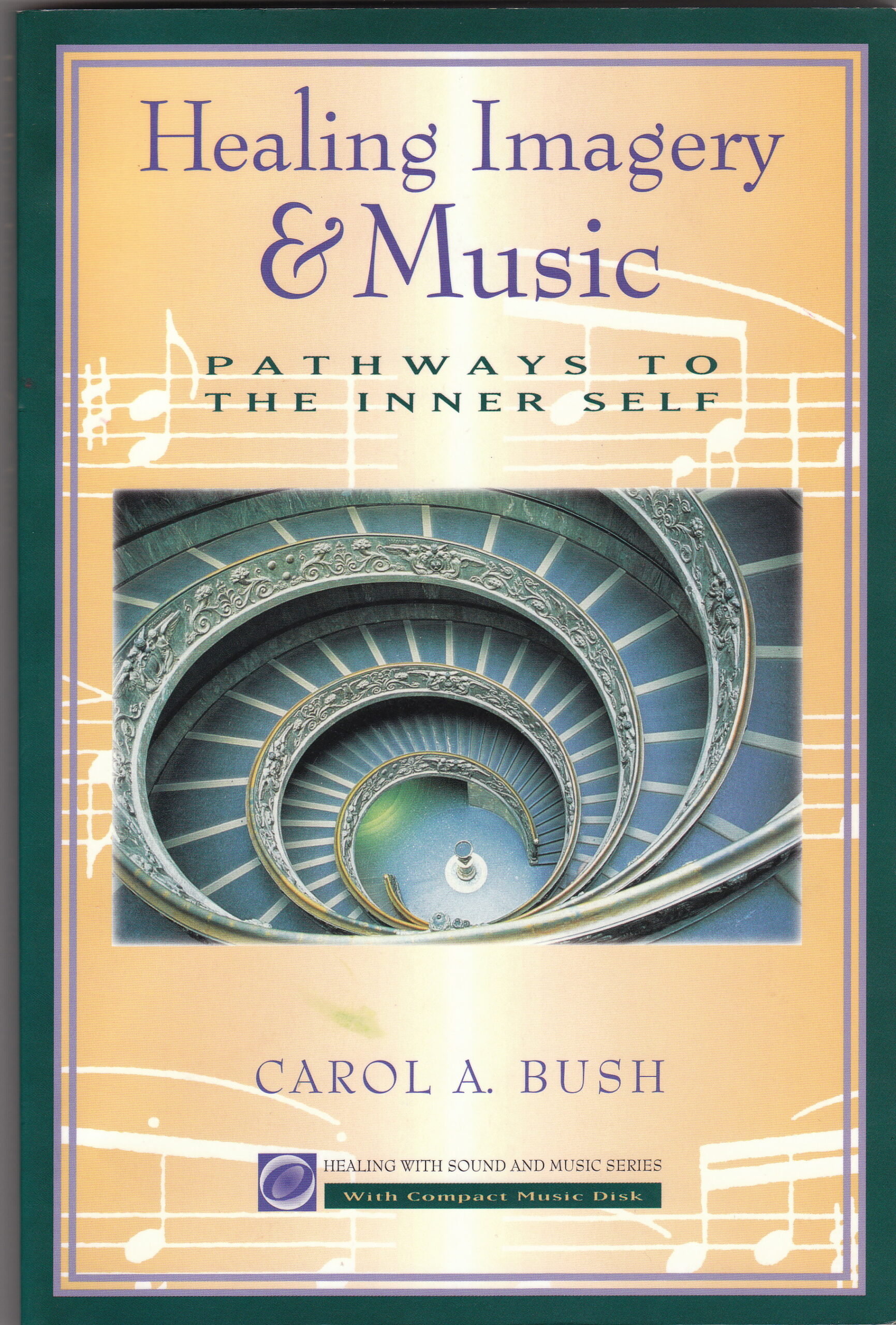
CAROL A. BUSH
Healing Imagery & Music: Pathways to the Inner Self
With companion CD
An introduction to the Bonny Method and its therapeutic applications, with practical exercises and classical music for the reader.
Podcasts, videos, and media

Selected publications by Atlantis faculty
Sierra Stokes Stearns
- “Letting the Sound Depths Arise” AMI Journal, 1992
- “The Music of Paradox” AMI Journal, 2014
- “A Jungian Orientation to GIM” The Bonny Method and Beyond, Vol. II, 2019
Carol A. Bush
- Healing Imagery & Music: Pathways to the Inner Self
- Published in AMI Journal, The Arts and Psychotherapy, The Mozart Effect, The Whole Mind
Ginger Clarkson
- Spiritual Dimensions of Guided Imagery and Music EN / ES
Nicki Cohen
- Advanced Methods in Music Therapy Practice Jessica Kingsley, 2017
Jim Borling
- Voices interview EN / JP
- Approaches interview →
Maria Montserrat Gimeno
- Multiple publications

Affiliated organizations
Institutional partners and regional BMGIM training centers
Training partners
Individual trainers with their own active practices